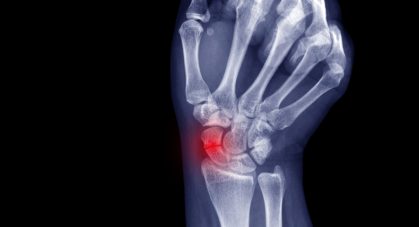





Our client was young, fit and healthy when he injured his right dominant wrist playing football. He attended his local A & E where they correctly undertook a full examination of his right wrist, to include a little bone in the wrist known as the scaphoid bone. When this bone was physically examined by the clinician, our client felt tenderness and so a wrist x-ray was undertaken which focused on this scaphoid bone, but no fracture was visible on the x-ray.
It is well known that a fracture to the scaphoid bone is not always immediately visible and so the clinicians correctly protected the bone by placing our client’s wrist in a splint and arranged fracture clinic follow up.
Unfortunately, when our client attended fracture clinic, the orthopaedic doctor reassured our client that it was just a soft tissue injury and discharged him with no support for his wrist.
Ongoing pain whilst Young, Fit and Healthy
Our client tried to get on with things as best he could but being very active and having a physical job, his ongoing wrist pain caused him difficulties.
A few months later, his right wrist was still painful and he was struggling with restrictive movement and so he saw his GP who referred him for physiotherapy. Physiotherapy didn’t materialise under the NHS, so he saw a private physiotherapist who immediately queried a missed scaphoid fracture and referred him to his local Urgent Treatment Centre.
There, tenderness over the scaphoid bone was recognised, as it should have been, and an x-ray of the scaphoid bone demonstrated an old fracture.
Fracture Treatment
Our client underwent surgery to fix the ongoing fracture and was in a cast for six weeks followed by a splint. He eventually made a really good recovery.
Expert Evidence from a Consultant Orthopaedic Surgeon
Our independent expert consultant orthopaedic surgeon was of the view that our client’s scaphoid fracture should have been diagnosed at the fracture clinic appointment at which time he would have been able to have a cast for six weeks and thereafter make a full recovery without the need for surgery or ongoing problems.
As a result of the delay in diagnosing and treating the scaphoid fracture, our client suffered an ongoing period of pain and restricted movement and needed an avoidable operation, and the recovery required from that.
Liability denied
The Defendant denied that they breached their duty of care in failing to diagnose the scaphoid fracture. They also denied that had our client’s fracture been diagnosed earlier, he would have avoided the need for surgery.
Challenging the Defendant’s position
We did not accept the Defendant’s position and asked our expert to consider this, following which our expert remained supportive of the claim.
We therefore challenged the Defendant’s position in the strongest of terms, but the Defendant maintained their denial of liability despite this.
Expert meeting
As liability had now been denied twice, we had a meeting with our client, an experienced clinical negligence barrister and our expert. This was a very productive meeting, and our expert remained supportive of the claim.
The barrister drafted a formal Schedule of our client’s losses, and we put forward a strong offer to the Defendant in the hope that we could resolve matters without our client having to go through the Court process.
A Life-Changing Settlement
Our client’s determination to work with us to resolve his claim paid off and we successfully persuaded the Defendant to make a reasonable settlement offer in the sum of £28,000 which our client gladly accepted as a life-changing sum of money for him.
Our client passed his thanks on to us and provided a glowing review on Trustpilot:
“I recently worked with Oliver & Co, I was working with Liz Fry, and had an excellent experience. Liz was incredibly professional, kept me informed throughout the process, and worked to achieve a great result. Communication was always clear and timely, which made the entire experience stress-free. I would highly recommend working with Liz and Oliver & Co Solicitors to anyone in need of assistance.”
Scaphoid fractures
Unfortunately, scaphoid fractures are often missed because the clinicians need to look for them for them to be diagnosed, both at the initial attendance and at follow-up attendances afterwards.
It is important to diagnose and treat a scaphoid fracture early as it can then usually successfully be treated by way of a cast with no ongoing long-term problems.
If there is a delayed diagnosis and treatment, it can result in ongoing pain and reduced function and the need for an operation.
We can help
If you or a loved one has experienced similar treatment delays, contact our Clinical Negligence team to discuss your case. We are here to help you seek justice and in ensuring accountability in patient care. Call us on 01244 312306 or complete our contact form and we will get in touch with you.